

INTRODUCTION
Trigonometry is most simply associated with planar right-angle triangles (each of which is a two-dimensional triangle with one angle equal to 90 degrees). The applicability to non-right-angle triangles exists, but, since any non-right-angle triangle (on a flat plane) can be bisected to create two right-angle triangles, most problems can be reduced to calculations on right-angle triangles. Thus the majority of applications relate to right-angle triangles. The standard trigonometric ratios Sine, Cosine and Tangent are introduced to determine the sides and angles of right-angled triangles. In the real world, not all triangles are right-angled. Can we still use Sine ratio to determine the sides and angles of such triangles? Using the following formulas for sine, cosine, tangent and cotangent we can determine the sides and angles.
-
Sine function (sin), defined as the ratio of the side opposite the angle to the hypotenuse.
-


-
Tangent function (tan), defined as the ratio of the opposite leg to the adjacent leg.

 | 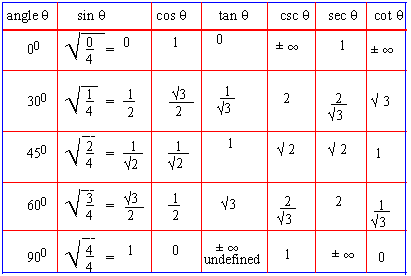 |
|---|---|
 |
This video shows how to memorize trigonometrical values using your fingers.
Trigonometry can be used in mathematics but also in day-by-day life. As you will see, on the next pages there are some examples of the use of trigonometry in different situations.